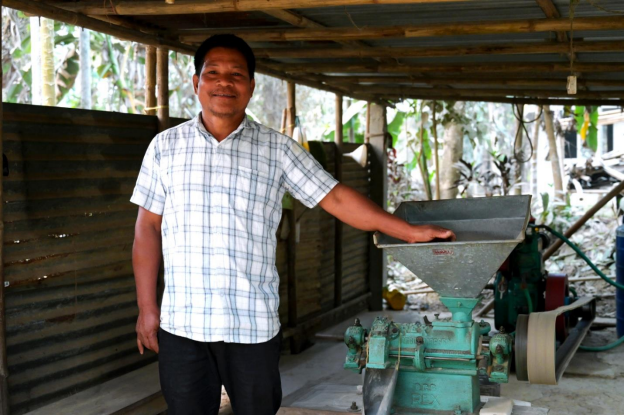
CLINTON SANGMA’S JOURNEY WITH IVCS
- admin's Blog
- Log in to post comments
Rural communities often depend on traditional farming and livelihood practices that provide basic sustenance but rarely allow families to rise above subsistence levels. Limited access to modern techniques, financial services, and structured support keeps many households trapped in cycles of uncertainty. To break this barrier and expand opportunities, rural families require consistent handholding, through financial assistance, training, and cooperative institutions that can help them diversify income sources, adopt improved practices, and build sustainable livelihoods. Financial inclusion is therefore not just about access to money; it is about empowering communities to move away from precarious daily wages toward stable, long-term ventures that uplift entire villages.
Recognizing these challenges, the Government of Meghalaya established 500 Integrated Village Cooperative Societies (IVCS) under the provisions of the Meghalaya Cooperative Societies Act, 2015. This initiative was launched through the Meghalaya Livelihoods and Access to Markets Project (MeghaLAMP), supported by IFAD and implemented by the Meghalaya Basin Management Agency (MBMA) under the Planning Department.
The primary objective of IVCS is to bridge the gap in financial services for rural households, especially those in remote and interior villages where formal banking networks cannot reach. By creating localized cooperative institutions, IVCS ensures that even the most marginalized communities gain access to credit, savings, and livelihood support. This model not only strengthens rural economies but also fosters collective growth, resilience, and self-reliance among villagers.
Clinton, from Makbilkol village in North Garo Hills, is today the Chairman of the Upper Kharkutta Four Brother Integrated Village Cooperative Society (IVCS). Before the IVCS was established on December 17, 2019, life was difficult for him. He worked as a local mason and daily wage laborer, earning just enough to cover his family’s basic needs. Savings were almost nonexistent, and financial insecurity weighed heavily on him, as it did on many rural workers with limited opportunities for growth.